Leave Your Message

2026 Best Wooden Aluminium Door Suppliers Worldwide?

Selecting the right Wooden Aluminium Door supplier in 2026 requires more than comparing glossy catalogs. A reliable supplier should combine durable timber, corrosion-resistant aluminum, accurate machining, and tested thermal performance. The best systems feel solid in the hand, close quietly, and remain stable after years of seasonal movement.

Building-performance expert Stephen Selkowitz offers a useful principle: “Energy efficiency must be treated as an integrated design challenge.” That idea matters here. A quality Wooden Aluminium Door depends on the frame, glazing, seals, thermal break, installation, and surrounding wall working together. Buyers should request test reports, material specifications, warranty terms, and project references. Standards such as EN 14351-1 and documented U-value calculations can support a more professional comparison. Still, paperwork alone cannot reveal every weakness.

This guide reviews leading global suppliers through practical criteria. These include manufacturing experience, timber selection, aluminum finishing, customization, delivery capability, and after-sales support. Climate also changes the decision. Coastal homes need stronger corrosion protection, while cold regions demand dependable airtightness and low heat transfer. Humid areas require careful timber coating and drainage design.

No ranking is perfect.

A beautiful showroom sample may hide poor installation support. A lower-priced offer may create higher maintenance costs later. This guide therefore considers evidence, not just brand visibility. Readers should still verify local building requirements, site conditions, and installer qualifications before ordering. The most suitable Wooden Aluminium Door is not always the most expensive one. It is the one that performs consistently where it is installed.
2026 Best Wooden Aluminium Door Suppliers Worldwide?

Wood-Aluminium Doors Explained: Materials, Construction, and Key Performance Terms

2026 Best Wooden Aluminium Door Suppliers Worldwide?

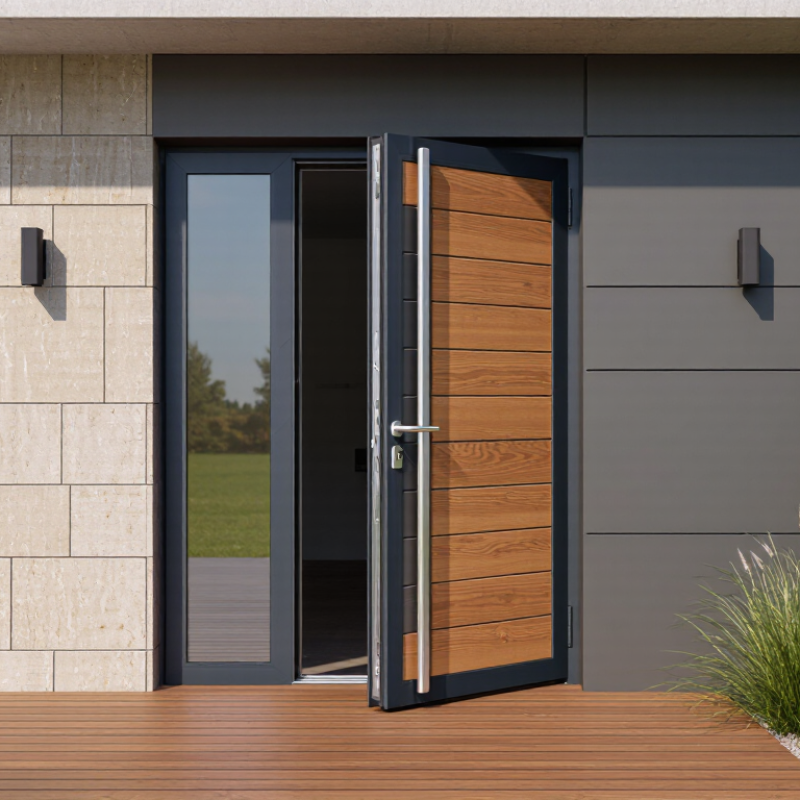
Wood-aluminium doors combine a warm timber interior with a weather-resistant aluminium exterior. The timber frame often uses laminated layers, reducing warping and visible movement. Aluminium cladding protects against rain, ultraviolet exposure, and surface damage. A thermal break separates conductive metal sections. Without it, the frame may feel cold and develop interior condensation.

Performance terms need careful reading. U-factor measures heat transfer; lower values indicate better insulation. Air leakage shows how much air passes through joints under pressure. Water penetration testing checks whether wind-driven rain reaches the interior. The Solar Heat Gain Coefficient, or SHGC, indicates how much solar energy enters through glazing. The International Energy Agency reported that buildings used about 30% of global final energy in 2022. Door design matters, but installation matters too.

Look for test results based on ISO 10077-1, EN 12207, and EN 12208, rather than vague “high performance” claims. A low U-factor can still disappoint if the sill drains poorly or the seals compress unevenly. Experience from site inspections shows this weakness repeatedly. Small gaps near hinges become noticeable on windy evenings. Timber species, coating thickness, glazing configuration, and threshold design should appear in the technical schedule. Certification is useful, but it is not a substitute for checking the actual opening, climate, and installation method. Even published figures may vary between laboratories.
How to Compare Suppliers Using Uw ≤0.8 W/m²K and EN 14351-1 Criteria

Choosing the best wooden aluminium door supplier in 2026 requires more than comparing brochures. Focus on verified thermal performance and product compliance. Ask for a complete test report showing Uw ≤ 0.8 W/m²K under stated size, glazing, frame, and spacer conditions. A low value without test details is weak evidence.

EN 14351-1 documentation should identify the door’s declared characteristics, air permeability, watertightness, wind resistance, and thermal performance. Check whether testing covers the exact construction you will purchase. Inspect the timber joints, aluminium thermal breaks, gaskets, and drainage channels. These small details often decide real-world comfort. Request factory quality records and independent laboratory evidence. Supplier experience matters, but evidence matters more.

Tips: Compare identical door sizes and glass packages. Clarify whether the supplier reports Uw, Ud, or another metric. Ask for installation guidance, not only product data. Visit a completed project if possible. A laboratory result may not match a poorly installed door. That is an uncomfortable limitation. I would also ask how performance changes after repeated opening, seasonal moisture, and transport. A confident supplier should answer clearly, admit testing limits, and provide traceable documents rather than promising perfection.

Global Supplier Screening: FSC Timber, ISO 9001 Quality, and Factory Capacity

2026 Best Wooden Aluminium Door Suppliers Worldwide?

Global supplier screening should begin with timber traceability, not showroom appearance. FSC Facts & Figures 2024 reports more than 160 million hectares covered by FSC-certified forests worldwide. Ask suppliers for a valid certificate, certification scope, and chain-of-custody documents. Match these records with purchase invoices and production batches. A logo alone proves little. I have seen polished samples supported by weak paperwork.

ISO 9001 is useful, but it does not certify door performance. The ISO Survey 2023 recorded 1,265,216 ISO 9001 certificates globally. Therefore, buyers should inspect the supplier’s quality procedures, inspection records, corrective actions, and testing equipment. Check moisture control, aluminium coating thickness, corner joints, glass installation, and final packaging. Short answers are warning signs.

Factory capacity needs physical verification. Request monthly output, active production lines, staffing levels, lead-time records, and recent delivery evidence. Compare claimed capacity with timber storage and machine utilization. Industry capacity sheets are often optimistic. That is my concern. A factory producing 5,000 doors monthly may struggle with a custom order of 800 units if scheduling is crowded. Independent audits, sample inspections, and video calls from the production floor provide stronger evidence. Supplier selection should reward traceable materials, repeatable processes, and realistic capacity rather than impressive promises.

2026 Best Wooden Aluminium Door Suppliers Worldwide? - Global Supplier Screening: FSC Timber, ISO 9001 Quality, and Factory Capacity

Anonymous supplier screening matrix based on commonly requested export, certification, production, and compliance criteria. Certification validity, production capacity, and test documentation should be verified before procurement.

Supplier Profile Primary Manufacturing Region Wood-Aluminium Door Configuration Typical Timber Options FSC Timber Evidence ISO 9001 Quality System Annual Factory Capacity Maximum Door Size Thermal Performance Target Weather and Air-Tightness Testing Export Readiness Screening Score
Supplier Profile 01 Central Europe Engineered timber core with external aluminium cladding European spruce, meranti, oak Certificate evidence available Certified system 8,000–12,000 doors/year 1,500 × 3,000 mm Target U-value: ≤ 1.0 W/m²K Air, water, and wind test reports available on request EU, UK, Middle East, North America 91/100
Supplier Profile 02 Western Europe Solid timber frame with thermally separated aluminium exterior Oak, larch, Douglas fir FSC Mix documentation Certified system 4,000–7,000 doors/year 1,400 × 2,800 mm Target U-value: ≤ 1.1 W/m²K Project-specific performance testing EU, Switzerland, Scandinavia 88/100
Supplier Profile 03 Eastern Europe Multi-layer laminated timber with powder-coated aluminium cover Spruce, pine, oak Supplier declaration; verify chain of custody Certified system 10,000–18,000 doors/year 1,600 × 3,200 mm Target U-value: ≤ 1.2 W/m²K Routine factory quality checks; independent reports recommended EU, Balkans, Central Asia 84/100
Supplier Profile 04 East Asia Finger-jointed timber core with insulated aluminium shell Meranti, ash, oak, pine FSC-certified input available Certified system 15,000–25,000 doors/year 1,800 × 3,600 mm Target U-value: ≤ 1.3 W/m²K Air and water reports available; wind-load review required North America, Australia, Middle East, Southeast Asia 86/100
Supplier Profile 05 South Asia Hardwood timber frame with ventilated aluminium rainscreen Meranti, teak substitute species, rubberwood FSC availability depends on timber species Evidence requires renewal check 6,000–10,000 doors/year 1,500 × 3,000 mm Target U-value: ≤ 1.5 W/m²K Third-party testing recommended for coastal projects Middle East, Africa, South Asia 76/100
Supplier Profile 06 North America Engineered wood frame with exterior aluminium extrusion system Douglas fir, white oak, pine FSC documentation available Quality system documented; certificate to verify 3,000–6,000 doors/year 1,400 × 2,700 mm Target U-value: ≤ 1.2 W/m²K North American weather-performance testing available United States, Canada, Caribbean 83/100
Supplier Profile 07 Oceania Stabilised hardwood frame with marine-grade aluminium cladding Spotted gum, radiata pine, oak Species and source verification required Certified system 2,500–5,000 doors/year 1,300 × 2,600 mm Target U-value: ≤ 1.6 W/m²K Strong focus on UV, salt-air, and moisture resistance Australia, New Zealand, Pacific Islands 81/100
Supplier Profile 08 Middle East Insulated timber-aluminium entrance doors for hot climates Engineered pine, oak veneer, meranti Project-specific documentation required Quality records available; certificate to verify 4,000–8,000 doors/year 1,600 × 3,200 mm Target U-value: ≤ 1.4 W/m²K Solar exposure, dust, and thermal-cycle testing recommended GCC, North Africa, East Africa 74/100
Supplier Profile 09 Latin America Certified plantation timber with powder-coated aluminium exterior Eucalyptus, pine, oak veneer Chain-of-custody evidence available Certified system 5,000–9,000 doors/year 1,450 × 2,900 mm Target U-value: ≤ 1.4 W/m²K Moisture and wind testing available by project South America, North America, Iberia 82/100
Supplier Profile 10 Nordic Region High-insulation laminated timber with aluminium weather shield Nordic pine, spruce, oak FSC or equivalent sustainable sourcing evidence Certified system 7,000–13,000 doors/year 1,500 × 3,100 mm Target U-value: ≤ 0.9 W/m²K Comprehensive cold-climate air, water, and wind testing Europe, Canada, Japan 93/100

Recommended verification documents: current FSC chain-of-custody certificate, valid ISO 9001 certificate, factory audit report, production-capacity evidence, product test reports, timber species declaration, aluminium coating specification, warranty terms, and recent export references.

2026 Cost, Lead-Time, Warranty, and After-Sales Comparison by Region

2026 Best Wooden Aluminium Door Suppliers Worldwide?

In 2026, supplier selection depends on more than catalogue photos. Typical wooden aluminium doors cost about USD 900–2,800 per unit before installation. European suppliers often offer tighter tolerances and five-to-ten-year finish warranties, but lead times may reach 8–14 weeks. North American projects commonly require 10–16 weeks, especially for custom glazing. Prices can increase sharply with oversized panels, coastal finishes, or unusual wood species.

Asia-Pacific suppliers may provide competitive pricing, often USD 600–1,800 per unit, with lead times near 6–10 weeks. However, sample approval and packaging checks matter greatly. Middle Eastern suppliers may deliver within 7–12 weeks, while heat-resistant coatings and high-performance seals can raise costs. Warranty terms vary by region. Ask whether coverage includes warping, powder-coat failure, hardware, and installation defects. A warranty without local service has limited practical value.

Tips: Request a corner sample, not only a full-size photograph. Check the joint between timber and aluminium, drainage paths, gasket compression, and hinge adjustment. Confirm who pays for replacement transport. Ask for a written after-sales response time, preferably within two business days. My experience is that the cheapest quotation often excludes site measurement and remedial fitting. That mistake is expensive. Suppliers should provide test reports, moisture-control guidance, spare hardware availability, and clear maintenance instructions. Still, no comparison is perfect; climate, building exposure, and installer skill can change the final result.

2026 Best Wooden Aluminium Door Suppliers Worldwide

Regional comparison of indicative supply cost, production lead time, warranty coverage, and after-sales performance

Average Warranty 3–5 years
Lowest Average Cost Asia-Pacific
Fastest Lead Time Asia-Pacific
Highest After-Sales Score Europe

Indicative 2026 market benchmarks for custom wooden aluminium doors. Costs are estimated delivered supply prices in USD per m², excluding installation, taxes, and unusual project requirements. Lead times represent typical production and export preparation periods. After-sales performance is an indicative 100-point benchmark based on service responsiveness, spare-part availability, and issue-resolution capability.

Top Supplier Selection Through Air, Water, Wind, Security, and Durability Tests

Choosing the best wooden aluminium door supplier in 2026 requires more than attractive photographs. The real evidence appears during controlled performance tests. Ask suppliers for air infiltration results using the complete door assembly, including seals, glass, frame, and hardware. Water testing should simulate wind-driven rain, not a simple hose spray. Check the pressure level, leakage location, and test duration. Small gaps near corners can become serious problems after installation.

Wind resistance deserves careful attention in exposed buildings. Reliable suppliers should provide pressure cycling data and explain the tested door size. A result from a small sample may not represent a large entrance door. Security testing should examine locks, hinges, cylinders, glass retention, and forced-entry resistance. Request reports from qualified, independent laboratories. Details matter.

Durability testing should include repeated opening cycles, moisture changes, temperature shifts, coating adhesion, and corrosion exposure. Wood movement is natural, so suppliers must explain joint design and maintenance requirements. Aluminium may resist weather well, but poor connections can still fail. I would also inspect production samples, not only certificates. Documents can be accurate yet incomplete. No test is perfect. Installation quality remains a weak point. Compare test conditions with the project’s climate, building height, and daily use. A supplier that discusses limitations openly often deserves more trust than one promising flawless performance.