Leave Your Message

Top Aluminium Bathroom Door Manufacturers and Suppliers

Choosing the right Aluminium Bathroom Door manufacturer or supplier requires more than comparing glossy product photographs. Bathroom doors face constant humidity, splashes, temperature changes, and frequent handling. A dependable supplier should understand these conditions through real production experience, not only sales language. Look for aluminium profiles with consistent thickness, corrosion-resistant finishes, accurate corner joints, and hardware designed for wet environments. Small details matter. A poorly aligned hinge can create noise, water gaps, and early wear.

This guide examines leading companies through practical and professional criteria. These include manufacturing capacity, quality-control procedures, customization options, delivery reliability, and after-sales support. Factory experience can often be seen in sample quality, packaging, installation guidance, and responses to technical questions. Reliable manufacturers should provide clear information about alloy grades, surface treatments, glass compatibility, testing methods, and warranty terms. Independent certifications and documented inspections can strengthen confidence, although paperwork alone is not proof of excellent performance.

No supplier is flawless. That deserves attention. Some companies offer impressive designs but limited support after delivery. Others provide stable quality yet fewer customization choices. Buyers should request physical samples, confirm dimensions, inspect finish consistency, and ask how damaged parts are handled. A door may look perfect online but feel weak in a real bathroom. Feedback from contractors and long-term users can reveal issues that brochures omit. By comparing evidence carefully, purchasers can identify an Aluminium Bathroom Door partner that balances design, durability, safety, and dependable service for residential, hotel, and commercial projects.
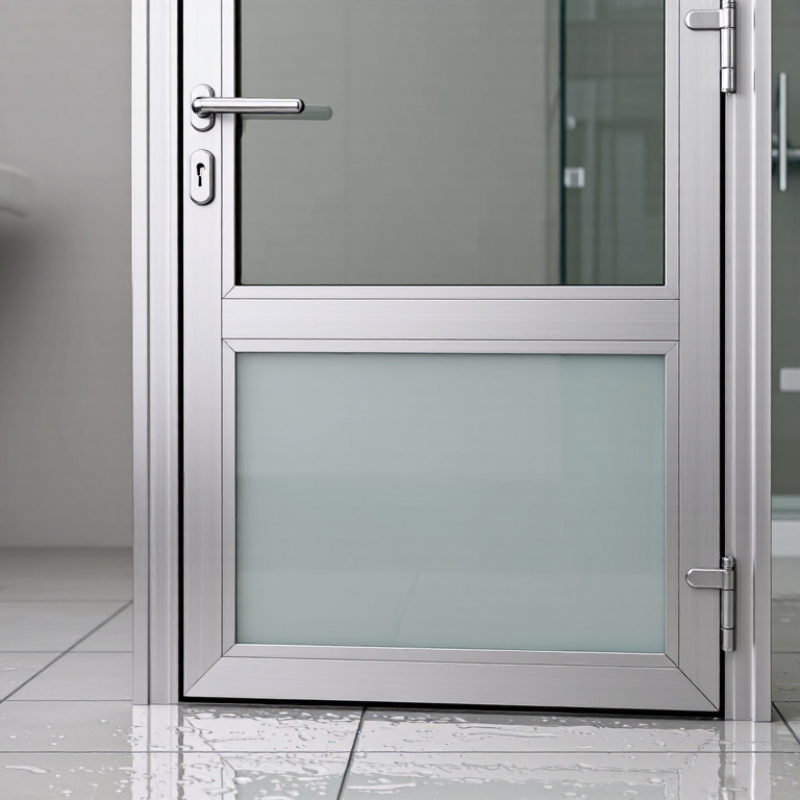
Top Aluminium Bathroom Door Manufacturers and Suppliers

Types of Aluminium Bathroom Doors and Their Key Features

Aluminium bathroom doors usually come in hinged, sliding, bifold, and louvered designs. Hinged doors provide a familiar, firm closure and can accommodate perimeter seals. They need clear floor space, which may be scarce in compact bathrooms. Sliding doors save that space. Their tracks need regular cleaning, since soap residue and hair can collect in the lower channel. Details matter.

Bifold doors fold toward one side, leaving a wider opening than many sliding layouts. Their extra hinges and rollers require careful installation and periodic checks. Louvered doors allow more airflow, but open slats can reduce privacy and sound control. They suit utility bathrooms better than every family bathroom. Not always.

Material choices also affect long-term performance. Aluminium resists moisture-related swelling, but coatings, fasteners, and seals still need to suit humid conditions. The International Aluminium Institute reports that recycling aluminium can use about 5% of the energy required for primary production. This is a material-level figure, not a bathroom-door footprint. Recycled-content frames may lower embodied energy, while durability, finish quality, and replacement frequency also matter. A practical specification should state frame finish, hardware material, seal type, and cleaning access. A door that looks sleek on day one can still disappoint if its track traps water.

This comparison shows defining design features, not measured performance ratings. A value of 1 indicates a characteristic feature of the listed door configuration; 0 means it is not a defining feature. The louvered example is shown in a hinged configuration.

How to Evaluate Aluminium Bathroom Door Manufacturers

Top Aluminium Bathroom Door Manufacturers and Suppliers

How to Evaluate Aluminium Bathroom Door Manufacturers

Evaluate a manufacturer by checking what sits behind the showroom sample. Ask for the aluminium alloy, frame-wall thickness, finish specification, and documented quality checks. The International Aluminium Institute’s aluminium recycling information reports that recycling uses about 5% of the energy required for primary aluminium production. If recycled content matters to your project, request traceable sourcing records rather than relying on a general sustainability claim. A clean sample can flatter the real product.

Check how the door performs in a damp room. Request finish and corrosion-test records, plus details about hinges, seals, and drainage. Ask whether the manufacturer tests complete doors or only individual parts. Inspect a production unit if possible: look for coating gaps around cut edges, uneven corners, and a latch that catches. A polished brochure cannot reveal these details.

Tips: Compare written specifications, not just prices. Inspect the corners. Then test the latch. Ask for warranty terms covering both the finish and hardware, and confirm how replacement parts are supplied. One overlooked detail—the seal’s fit against a tiled threshold—can matter more than a thicker-looking frame.

Top Aluminium Bathroom Door Manufacturers and Suppliers - How to Evaluate Aluminium Bathroom Door Manufacturers

Suggested evaluation framework for comparing suppliers. Scores and acceptance criteria are procurement guidelines, not universal industry requirements; confirm applicable building codes and project specifications.

Evaluation dimension Weight What to evaluate Evidence to request Suggested scoring guide
Product suitability and configuration 15% Availability of suitable hinged or sliding designs, opening direction, dimensions, thresholds, ventilation options, and compatibility with the project opening. Dimensioned drawings, configuration schedule, installation details, and confirmation of project-specific options. Higher score for complete drawings and clearly confirmed customization.
Aluminium profile and construction 15% Declared alloy and temper, profile dimensions, wall thickness, frame and sash construction, corner joints, and suitability for the door size and expected use. Profile cross-sections, material specifications, fabrication details, and sample inspection. Verify the proposed construction against the project requirements rather than relying on a generic thickness claim. Higher score for traceable specifications and consistent fabrication controls.
Finish and corrosion resistance 12% Finish type and color, surface preparation, coating or anodizing specification, finish consistency, and suitability for a humid indoor environment. Written finish specification, available samples, process or inspection records, and applicable coating or anodizing test documentation. Higher score for a defined finish specification and documented quality checks.
Glazing and safety provisions 10% If glazed, verify glass type, thickness, edge treatment, retention method, and safety-glazing compliance for the destination market and installation location. Glass specification and relevant test or conformity documents. For example, EN 12150-1 covers thermally toughened soda lime silicate safety glass; confirm local code applicability. Higher score when glass documentation matches the proposed door and applicable local requirements.
Hardware and moisture management 10% Hinge or roller capacity, latch and handle materials, replaceability, seals, drainage details, and resistance to corrosion from regular bathroom use. Hardware schedule, material declarations, load or cycle information where available, and details showing how water is managed at the opening. Higher score for clearly specified, serviceable hardware and appropriate seals.
Quality management and inspection 12% Incoming material checks, dimensional inspection, finish checks, assembly controls, product identification, and handling of nonconforming products. Quality procedures, sample inspection reports, traceability records, and any current quality-management certificates. Verify certificates with the issuing body. Higher score for documented inspections and verifiable, relevant certification.
Production capacity and lead time 8% Capacity for the required order quantity, production scheduling, packaging, shipping arrangements, and ability to communicate changes. Lead times vary by specification, order size, and destination. A project-specific production and delivery schedule, order-capacity confirmation, packaging details, and updates or escalation process. Higher score for a clear, realistic schedule and demonstrated capacity for the order.
Installation support and documentation 6% Clarity of installation instructions, required opening tolerances, fixing methods, adjustment guidance, and availability of technical assistance. Installation manual, fixing details, maintenance instructions, and written confirmation of technical support availability. Higher score for complete, project-relevant instructions and responsive support.
Warranty and after-sales service 7% Warranty coverage, exclusions, claim process, spare-parts availability, and response arrangements. Warranty terms differ by supplier and component. Written warranty terms, service contact details, claims procedure, and parts availability information. Higher score for clear, practical terms and defined after-sales support.
Commercial clarity and total cost 5% Compare like-for-like quotations, including door and hardware specifications, packaging, freight, taxes, installation responsibilities, and payment terms. Itemized quotation, scope exclusions, delivery terms, payment schedule, and validity period. Higher score for transparent pricing and clearly defined scope.
Total 100% Score each supplier against the same project specification and verify important claims with documents or samples.

Leading Regions and Supplier Selection Criteria

For aluminium bathroom doors, supplier geography matters, but manufacturing capability matters more. East and South Asia offer broad extrusion and fabrication networks; Turkey and Gulf-region suppliers may suit projects seeking shorter routes across nearby markets. These are useful starting points, not a reliable ranking. The International Aluminium Institute reported 70.6 million tonnes of primary aluminium production worldwide in 2023. That figure describes raw-metal output, not finished-door capacity, so buyers should verify each factory’s extrusion, coating, and assembly operations.

Request specifications for frame-wall thickness, alloy, finish, hardware, and dimensional tolerances. Ask for recent salt-spray or coating test records, and check whether the tested sample matches the proposed production finish. Look closely at the lower frame corners and hinge fixing points; small gaps or weak reinforcement can become noticeable in a humid bathroom. Also confirm packaging, replacement-part availability, and delivery terms in writing. A low quotation can still cost more if damaged panels or inconsistent dimensions delay installation.

Tips: Compare two or three suppliers using the same drawing and finish sample. Ask for production photos and inspection records, not only a showroom sample. A polished sample can hide uneven batch quality; that is easy to overlook. Test communication with one technical question before placing an order.

Manufacturing Standards, Materials, and Quality Control

Aluminium bathroom doors face daily humidity, splashes, and frequent cleaning. A suitable frame alloy should resist corrosion and hold its shape; extruded aluminium is common because its profiles can be made consistently. Ask how the supplier checks wall thickness and dimensions, especially around hinges and corner joints. Small variations can cause rubbing or uneven gaps. Details matter.

Surface protection deserves close attention. Anodizing and powder coating are common finishes, but the process and inspection records matter as much as the finish name. Suppliers should explain how coating thickness, adhesion, and colour consistency are checked. Ask for recent test reports and batch traceability, not just a general quality claim. A published test does not guarantee identical performance in every bathroom. No checklist catches everything.

Reliable quality control includes checks at several stages: incoming material, machining, assembly, and final inspection. For a sample door, inspect the edges, drainage details, fasteners, and smoothness of operation. Ask how defects are documented and corrected. Production is never perfectly uniform; what matters is whether deviations are found before dispatch. It is easy to focus on polished samples and overlook the less visible details. Those details often reveal how carefully a supplier works.

Pricing, Customization, Installation, and After-Sales Support

A useful quote for an aluminium bathroom door should list more than the panel price. Check the frame dimensions, aluminium thickness, finish, hinges, lock, seals, and delivery charges. Compare like-for-like specifications. A low initial price may exclude measurement or installation. Ask directly.

Customization should suit the opening and daily use. Suppliers may offer sliding or hinged designs, different frame colours, frosted panels, and made-to-measure sizes. Confirm how the finish and hardware handle regular moisture, and request care instructions. For installation, check that the wall opening is measured accurately and the floor is reasonably level. Small errors can affect clearance and sealing. Not always obvious.

After-sales support matters when a door needs adjustment or a part is missing. Before ordering, ask what the warranty covers, how replacement parts are supplied, and who handles service enquiries. Keep the approved measurements and product specifications in writing. One practical caution: warranty terms may distinguish product faults from installation issues, so clarify responsibility before work begins. Details matter.